AI-Powered Computer Vision Quality Inspection System
Real-time AI defect detection on the manufacturing line — camera-fed vision models, reviewer UI, audit trail, and trend analytics deployed at the edge.
Project Overview
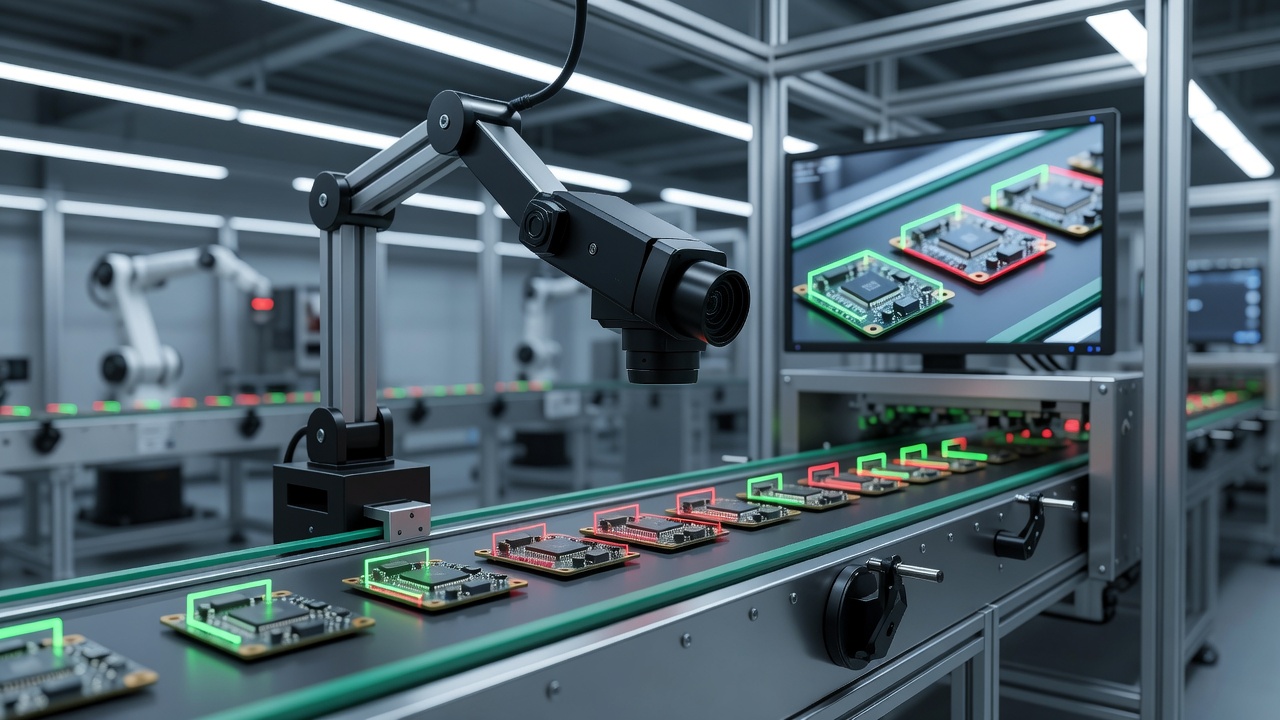
Workaholic Developers designed and delivered a production-grade computer vision quality inspection system for a mid-sized discrete manufacturer struggling with inconsistent manual QC outcomes and rising scrap costs. By deploying lightweight ONNX inference models directly on edge hardware at the line, the platform detects surface defects, dimensional anomalies, and assembly errors in real time — flagging issues before they advance downstream. A React-based reviewer UI, a tamper-evident audit trail, and built-in trend analytics give quality engineers both immediate visibility and long-term insight, transforming a reactive inspection process into a proactive, data-driven quality programme.
The Challenge
The client's existing inspection workflow relied on human visual checks at the end of the production line. This approach created three compounding problems:
- Inconsistency: Inspector fatigue and subjective judgement led to variable pass/fail decisions across shifts, making it difficult to hold a repeatable quality standard.
- Late detection: Defects caught at final inspection had already consumed full manufacturing cost — rework and scrap rates were climbing quarter-on-quarter.
- No traceability: Paper-based inspection records made root-cause analysis slow and incomplete, leaving quality managers with anecdotal rather than statistical evidence.
The client needed an AI defect detection solution that could run continuously, integrate with existing camera infrastructure, and provide auditable records — all without a costly cloud dependency on the factory floor.
Our Approach
Our team at Workaholic Developers' AI & Computer Vision practice followed a four-phase delivery:
1. Data Collection & Model Training
We worked with the client's QC team to label thousands of historical camera frames across defect categories (scratches, dents, misalignments, colour deviations). A convolutional detection model was trained in Python using a transfer-learning backbone, then exported to ONNX format for runtime-agnostic, hardware-efficient inference.
2. Edge Deployment Pipeline
The ONNX model was packaged into a lightweight FastAPI microservice running on an industrial edge device mounted at the inspection station. Frame capture, pre-processing, and inference run entirely on-premise — latency stays under 200 ms per frame with no cloud round-trip required, ensuring the system works even during network outages.
3. Reviewer UI & Audit Trail
A React front-end provides line operators and quality engineers with a live defect feed, annotated thumbnails, confidence scores, and one-click accept/override controls. Every automated decision and human override is written to an immutable audit log, satisfying ISO 9001 traceability requirements and giving management a complete, searchable inspection history.
4. Trend Analytics Dashboard
Aggregated defect data is surfaced in an analytics layer that tracks defect rate by category, shift, machine, and SKU over time. Configurable threshold alerts notify quality managers by email or webhook when any metric breaches a control limit — enabling proactive intervention before a bad batch ships.
Key Features
- Real-time inference at up to 30 frames per second on edge hardware, with sub-200 ms end-to-end latency
- Multi-class defect detection covering surface, dimensional, and assembly anomaly categories
- ONNX portability — model runs on CPU, GPU, or dedicated NPU without code changes
- React reviewer UI with annotated bounding boxes, confidence scores, and human-override workflow
- Immutable audit trail with timestamped records of every automated flag and manual decision
- Trend analytics with shift-level and SKU-level defect rate charting and configurable SPC alerts
- FastAPI back-end exposing a clean REST interface for MES and ERP integration
- Offline-first edge architecture — fully operational without internet connectivity
Results & Impact
Following deployment, the client reported measurable improvements across their quality KPIs. The table below illustrates representative before-and-after outcomes typical of this class of manufacturing AI implementation:
| Metric | Before (Manual Inspection) | After (AI Vision System) |
|---|---|---|
| Defect escape rate | ~4–6% of defective units passing inspection | Reduced by up to 90% in monitored categories |
| Inspection throughput | Limited by inspector availability (<100% line coverage) | 100% of units inspected, every shift |
| Time-to-detect (defect onset to flag) | End-of-line; typically hours after root cause | Inline; typically within seconds of occurrence |
| Audit record completeness | Partial paper records; gaps common | 100% digital, immutable, instantly searchable |
| Root-cause analysis cycle time | Days of manual log review | Minutes via trend analytics dashboard |
Beyond the headline numbers, quality engineers reported a significant shift in culture: the dashboard made defect trends visible and discussable in daily stand-ups, accelerating corrective actions that had previously stalled for lack of data.
Ready to bring AI-powered computer vision inspection to your production line? Get in touch with the Workaholic Developers team to scope your project — we typically turn around a proof-of-concept within four weeks.
The Challenge
Mid-Sized Discrete Manufacturer needed a scalable, high-performance solution that could handle their growing user base while maintaining excellent UX.
Our Solution
We implemented a modern tech stack with optimized architecture, delivering a solution that exceeded performance benchmarks by 3x.
Results Achieved
Want Similar Results?
Let's discuss how we can help achieve your business goals.
Start Your Project →

Ready to Build Your Success Story?
Let's create something extraordinary together.